Best Full-Body Exercises for Beginners
Starting a workout routine can feel complicated when you see hundreds of exercises, machines, and training methods online. Beginners often wonder which exercises they should actually perform and whether they need a long list of movements to get results.
The good news is that you can build a strong foundation with a relatively small selection of effective full-body exercises. The key is to choose movements that train major muscle groups, learn proper technique, and gradually increase the challenge as your fitness improves.
Full-body exercises can be particularly useful for beginners because many of them involve several muscles and joints working together. They can help improve strength, coordination, balance, and general physical capacity while making efficient use of your workout time.
This guide covers some of the most useful full-body exercises for beginners, how to perform them safely, how to modify them, and how to combine them into a simple workout routine.
What Are Full-Body Exercises?
A full-body exercise involves multiple muscle groups rather than focusing exclusively on one small area.
For example, a squat primarily trains the lower body but also requires your core and upper body to stabilize your position. A push-up trains the chest, shoulders, and triceps while also requiring your core to maintain a stable body position.
Full-body movements don’t necessarily train every muscle equally. Instead, they allow you to involve several major muscle groups within one exercise.
Why Are Full-Body Exercises Useful for Beginners?
Full-body movements can make workouts more efficient.
If you only have a limited amount of time to exercise, choosing movements that train several muscles at once can help you get more from your session.
They can also help beginners develop fundamental movement skills that transfer to other exercises and everyday activities.
Instead of immediately learning dozens of isolated movements, beginners can focus on a few fundamental patterns and gradually expand their routine.
1. Bodyweight Squat
The bodyweight squat is one of the simplest ways to learn the squat movement.
Stand with your feet in a comfortable position. Keep your torso controlled and begin bending your hips and knees while lowering your body. Descend only as far as you can comfortably maintain good technique, then push through your feet to return to the starting position.
Squats primarily challenge the muscles of the legs and hips while also requiring trunk stability.
Beginners can practice bodyweight squats before adding external resistance.
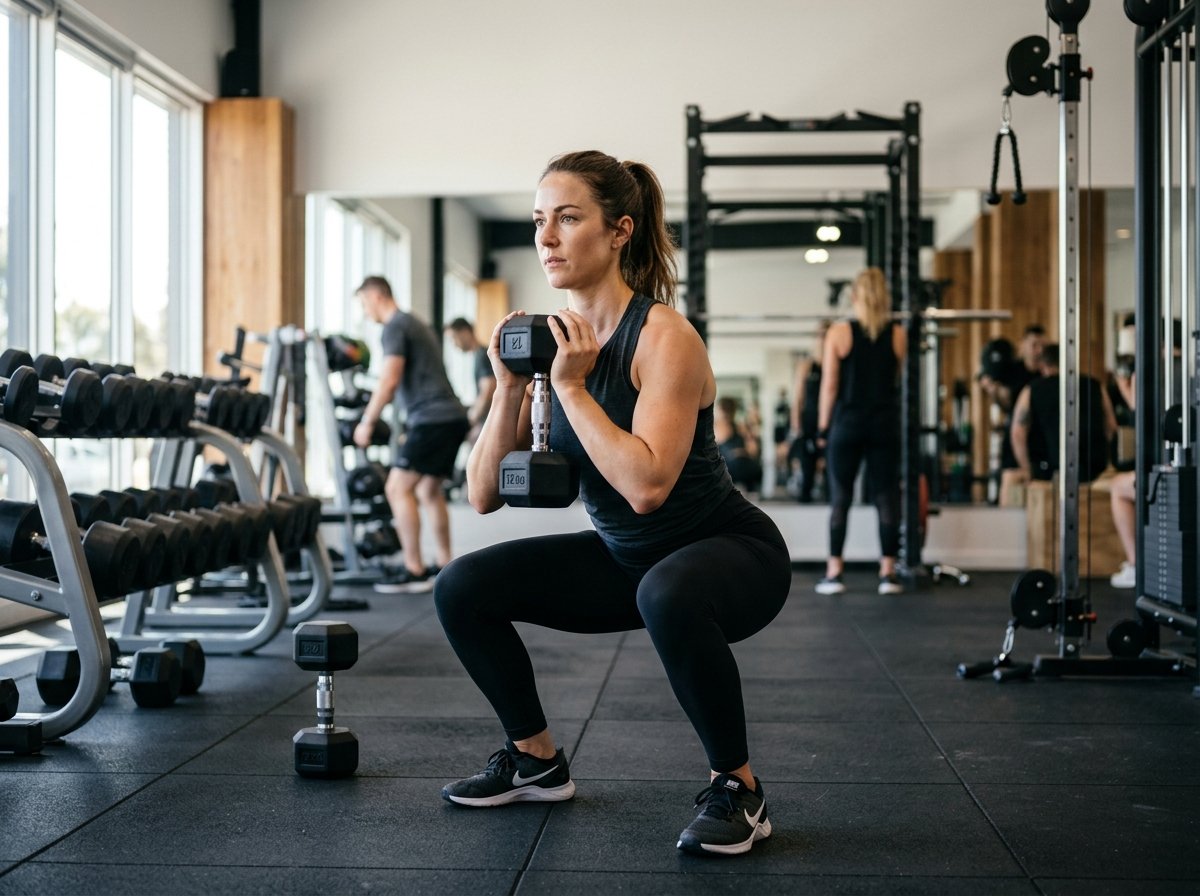
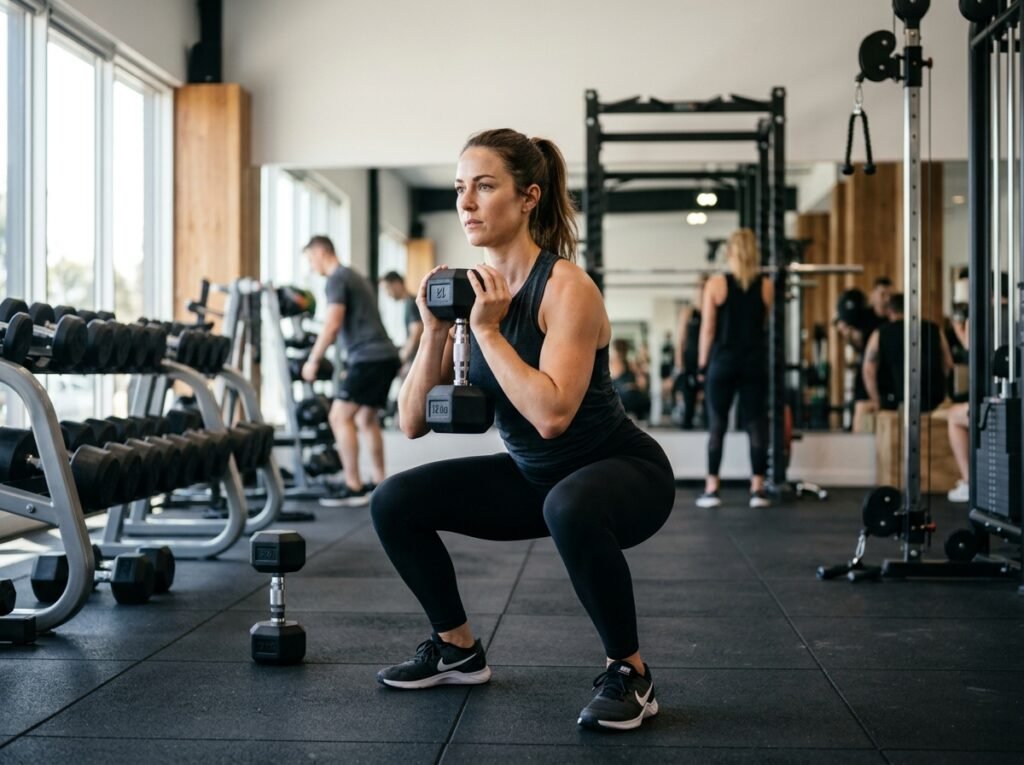
2. Goblet Squat
The goblet squat is a useful progression from the bodyweight squat.
Hold one dumbbell or kettlebell close to your chest while performing the squat movement.
The additional resistance increases the challenge while the position of the weight can help beginners maintain a controlled posture.
Start with a light resistance and focus on smooth, controlled repetitions.
3. Push-Up
Push-ups are a classic bodyweight exercise that primarily train the chest, shoulders, and triceps while requiring the core to stabilize the body.
Begin in a position where your hands are placed comfortably beneath or slightly wider than your shoulders. Keep your body controlled as you lower your chest toward the floor, then push through your hands to return to the starting position.
If a standard push-up is too difficult, use an elevated surface such as a sturdy bench or countertop.
As you become stronger, you can gradually work toward standard floor push-ups.
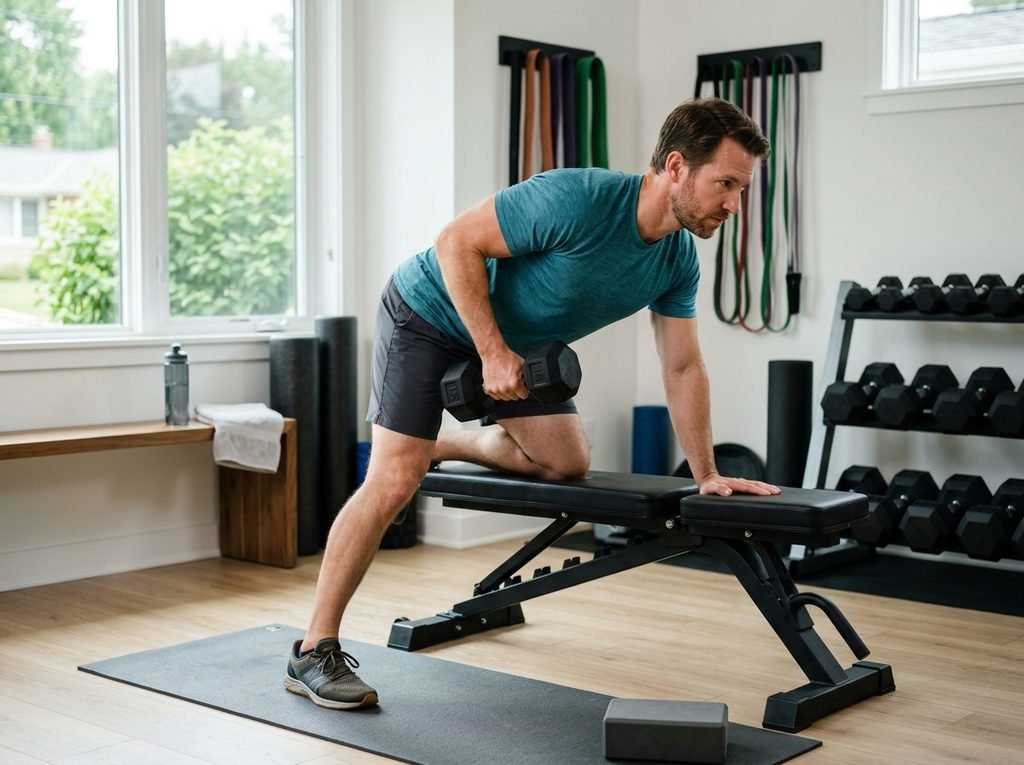
4. Dumbbell Row
Rows train pulling muscles in the upper back and arms.
For a basic dumbbell row, support yourself appropriately, keep your torso controlled, and pull the dumbbell toward your body while keeping the movement deliberate.
Avoid using excessive momentum to move the weight.
The goal is to control the resistance throughout the exercise.
5. Reverse Lunge
Reverse lunges train the legs and hips while also challenging balance and coordination.
From a standing position, step one foot backward and lower your body under control. Push through the front foot to return to the starting position.
Alternate sides or complete your repetitions on one side before switching.
Beginners who have difficulty balancing can use a stable support for assistance.
6. Romanian Deadlift
The Romanian deadlift is a hip-hinge exercise that primarily challenges the muscles of the back of the legs and hips.
Hold suitable weights and keep them close to your body. Push your hips backward while keeping your spine controlled. Lower the weights only as far as you can maintain good technique, then drive your hips forward to return to the starting position.
Learning the hip hinge without heavy resistance is important before progressing to heavier weights.
7. Dumbbell Shoulder Press
The dumbbell shoulder press primarily trains the shoulders and arms while also requiring trunk stability.
Hold a pair of light dumbbells at approximately shoulder level and press them upward in a controlled manner. Return them slowly to the starting position.
Avoid using more resistance than you can control.
Beginners can perform the exercise seated if that provides better stability.
8. Glute Bridge
The glute bridge is a simple exercise that targets the muscles around the hips and back of the legs.
Lie on your back with your knees bent and your feet positioned comfortably on the floor.
Lift your hips while maintaining control, pause briefly at the top, and then lower them slowly.
This exercise can be performed without equipment and is a useful option for beginners learning to engage the hips.
9. Step-Up
Step-ups involve stepping onto a stable elevated surface and returning to the starting position.
They train the legs and hips while also challenging balance and coordination.
Choose a platform height that allows you to perform the movement safely and comfortably.
Hold onto a stable support if you need additional balance.
10. Plank
The plank is a simple exercise for developing core endurance.
Position your body so that your trunk remains controlled while supporting yourself through your hands or forearms and feet.
Instead of trying to hold a plank for an extremely long time, focus on maintaining good body alignment.
Shorter, controlled holds can be more useful than allowing your posture to collapse simply to reach a longer time.
11. Farmer’s Carry
The farmer’s carry is a simple movement that involves walking while holding weights at your sides.
It can challenge your grip, shoulders, trunk, and lower body while requiring you to maintain stable posture as you walk.
Use manageable weights and walk in a clear, safe area.
Keep your torso controlled and avoid leaning excessively to one side.
12. Resistance-Band Row
If you train at home, resistance bands can provide a convenient way to perform pulling exercises.
Secure the band appropriately and pull the handles or band toward your body while keeping your shoulders controlled.
Resistance-band rows can be adjusted by changing the band resistance or your distance from the anchor point.
How to Choose the Right Exercises
You don’t need to perform all of these exercises during one workout.
A beginner routine can start with four to six movements that cover several major movement patterns.
For example, you could combine a squat, push, pull, hip hinge, single-leg movement, and core exercise.
This approach creates a balanced workout without overwhelming you with too many exercises.
Focus on Movement Quality
When you’re learning a new exercise, prioritize movement quality over the amount of weight you can lift.
Perform each repetition slowly enough to maintain control and understand the movement.
As your technique improves, you can gradually increase resistance or choose a more challenging variation.
How Many Exercises Should Beginners Perform?
There is no universal number of exercises that every beginner must perform.
Four to six exercises can be enough for a simple full-body session, especially when you’re new to resistance training.
The number can increase gradually as your experience and recovery capacity improve.
Remember that more exercises don’t automatically mean a better workout.
How Many Sets and Repetitions Should You Do?
Beginners don’t need complicated training formulas to get started. A practical approach is to perform a manageable number of sets and repetitions while focusing on good technique.
For many exercises, beginners can start with a few controlled sets and a repetition range that allows them to complete the movement without losing form.
The right number will depend on the exercise, your fitness level, resistance, and training experience.
As you become more comfortable, you can gradually increase repetitions, resistance, or sets.
How Much Weight Should You Use?
Choose a resistance that challenges you while allowing you to maintain proper technique.
If you have to swing the weight, hold your breath excessively, or change your body position simply to complete a repetition, the resistance may be too heavy.
On the other hand, if every repetition feels extremely easy and you could perform many more repetitions without meaningful effort, you may eventually need to increase the challenge.
Start conservatively and progress gradually.
How Often Should You Perform Full-Body Workouts?
Many beginners can start with two or three full-body strength sessions per week.
Spacing sessions throughout the week can give your muscles time to recover between workouts.
For example, you could train on Monday, Wednesday, and Friday, with easier activity or rest on the other days.
Your schedule doesn’t have to follow this exact pattern. The best schedule is one that fits your lifestyle and allows you to train consistently.
Simple Beginner Full-Body Workout
Here is an example of a straightforward full-body workout:
- Bodyweight or goblet squat: Lower and raise your body with controlled movement.
- Push-up: Use a modified version if necessary.
- Dumbbell row: Pull the weight toward your body while maintaining control.
- Romanian deadlift: Practice the hip-hinge pattern with manageable resistance.
- Reverse lunge: Alternate legs while maintaining balance.
- Plank: Maintain a stable trunk for a controlled period.
This is an example rather than a personalized training program. Beginners should adjust exercise selection, resistance, volume, and frequency according to their individual abilities.
Warm Up Before Your Workout
A short warm-up can help prepare your body for physical activity.
Start with several minutes of light movement, such as walking or easy cycling, followed by movements related to the exercises you plan to perform.
You can also perform lighter sets before using your normal training resistance.
A warm-up should prepare you for exercise rather than make you tired before your actual workout begins.
Rest Between Workouts
Recovery is an important part of strength training.
Your muscles and other tissues need time to adapt to the demands of exercise.
If you are extremely fatigued or unusually sore, consider allowing additional recovery before performing another demanding session.
Rest days don’t mean you have to remain completely inactive. Walking, gentle mobility work, or other low-intensity activities can be appropriate depending on your fitness level and recovery.
How to Make These Exercises More Difficult
As your strength improves, exercises that once felt challenging may become easier.
That’s when you can gradually increase the difficulty.
For example, you could add dumbbells to squats, use a lower push-up surface, increase resistance on a row, or use a slightly heavier weight during a farmer’s carry.
You can also increase repetitions or improve your control and range of motion when appropriate.
Progress should be gradual. There is no need to make dramatic changes every workout.
Common Beginner Mistakes
Trying Too Many Exercises
Beginners sometimes believe that a workout must contain ten or fifteen different exercises.
This can make training unnecessarily long and difficult to recover from.
Start with a small selection of effective movements and learn them well.
Using Too Much Weight
Heavy resistance can make exercises more difficult, but it doesn’t automatically make them more effective.
If excessive weight prevents you from maintaining good technique, reduce the resistance.
Moving Too Quickly
Fast repetitions can make it harder to control resistance.
Use a deliberate pace and focus on the movement rather than simply trying to complete repetitions as quickly as possible.
Ignoring Pulling Exercises
Some beginners perform many push-ups and presses but rarely train their back.
Include pulling movements such as rows to create a more balanced routine.
Skipping Lower-Body Training
Training only the upper body can create an unbalanced program.
Include exercises that train your legs and hips, such as squats, lunges, step-ups, and hip-hinge movements.
Expecting Immediate Results
Strength and fitness develop gradually.
Focus on improving your workouts over time instead of expecting dramatic physical changes after a few sessions.
Bodyweight vs Weights
Both bodyweight exercises and external weights can be useful.
Bodyweight movements are convenient and can be performed almost anywhere. They are particularly useful for beginners who are learning basic movement patterns.
Weights allow you to make smaller and more precise increases in resistance, which can become useful as you get stronger.
You don’t necessarily need to choose one method permanently. A combination of bodyweight exercises, dumbbells, resistance bands, and machines can provide plenty of variety.
Full-Body Exercises and Everyday Movement
Many full-body exercises resemble movements you perform in daily life.
Squatting can help you become more comfortable getting up and down. Carrying weights can challenge your ability to stabilize your body while carrying objects. Lunges and step-ups involve single-leg movement and balance.
This doesn’t mean every exercise needs to perfectly imitate an everyday activity. It simply highlights why learning fundamental movement patterns can be useful beyond the gym.
When Should You Stop an Exercise?
Muscular effort and fatigue are normal during strength training, but you should not ignore sharp, severe, or unusual pain.
If an exercise causes significant discomfort or you cannot maintain safe technique, stop the movement and reassess.
Beginners should also avoid attempting advanced exercises simply because they appear impressive.
Build your foundation first and progress when you’re ready.
How to Stay Consistent
The best workout is one you can perform consistently.
Choose exercises you feel comfortable doing and create a schedule that fits your daily life.
If you dislike crowded gyms, consider home workouts. If you enjoy exercising around other people, a gym may be more motivating.
Keep your initial routine simple enough that you can realistically maintain it.
Consistency over several months is more valuable than following a perfect program for only a few weeks.
Frequently Asked Questions
What is the best full-body exercise for beginners?
There isn’t one single best exercise. Squats, push-ups, rows, lunges, hip hinges, step-ups, carries, and planks can all be useful depending on your goals and abilities.
Can beginners do full-body workouts every day?
Most beginners don’t need to perform demanding full-body strength workouts every day. Allowing recovery between challenging sessions is important.
Can I build strength without going to a gym?
Yes. Bodyweight exercises, resistance bands, and home weights can provide effective resistance training without requiring a commercial gym.
Are full-body workouts good for weight loss?
Strength training can be part of a weight-management program because it helps develop and maintain muscle. However, body-weight changes are influenced by overall energy intake, activity, sleep, and many other factors.
Should I do cardio before or after strength training?
It depends on your goals and the type of training you’re doing. If strength is your main priority, you may prefer to perform your strength work when you’re relatively fresh and place longer cardiovascular work afterward or on another day.
How long should a beginner workout last?
A beginner workout can be relatively short and still productive. Focus on quality exercises, controlled technique, appropriate rest, and gradual progression rather than trying to make the session as long as possible.
Do I need equipment for full-body exercises?
No. Many useful full-body movements can be performed with body weight. Equipment such as dumbbells or resistance bands simply provides additional ways to increase resistance.
Final Thoughts
Full-body exercises are an excellent starting point for people who are new to strength training.
You don’t need a complicated workout containing dozens of movements. A small selection of exercises covering squatting, pushing, pulling, hinging, single-leg movement, and core stability can provide a strong foundation.
Start with exercises that match your current ability. Learn proper technique, use manageable resistance, and gradually increase the challenge as your strength improves.
Remember to warm up, allow enough recovery between demanding sessions, and avoid comparing your progress with other people.
The goal isn’t to complete the hardest workout possible. The goal is to develop strength and fitness through consistent training that you can maintain over the long term.
Whether you train at home or in a gym, the fundamentals remain the same: move with control, challenge your muscles appropriately, recover well, and progress gradually.
With consistency and patience, these basic exercises can become the foundation of a much stronger and healthier fitness routine.
Beginner Full-Body Workout Checklist
- Choose four to six fundamental exercises.
- Include a squat or leg movement.
- Include a pushing exercise.
- Include a pulling exercise.
- Include a hip-hinge movement.
- Add a core exercise.
- Use manageable resistance.
- Prioritize proper technique.
- Warm up before demanding exercise.
- Allow adequate recovery.
- Increase difficulty gradually.
- Stay consistent with your training schedule.