10 Easy Exercises for Beginners: A Simple Full-Body Workout at Home
Starting a fitness routine can feel harder than it actually is. You may think you need an expensive gym membership, complicated equipment, or hours of free time before you can begin. The truth is much simpler: your body is already a useful piece of exercise equipment, and a few basic movements can give you a solid starting point.
If you are new to exercise, the most important thing is not trying to do everything at once. A good beginner workout should help you become comfortable with movement, build consistency, and gradually improve your strength and fitness. You don’t need to finish your first workout exhausted. In fact, learning how to exercise at a comfortable pace can make it much easier to stay consistent over time.
This beginner-friendly full-body workout includes ten simple exercises that can be performed at home with little or no equipment. The movements target major muscle groups while also helping you develop balance, mobility, coordination, and general fitness.
Before starting, choose a clear area where you can move comfortably. Wear comfortable clothing and supportive shoes if needed. Keep some water nearby, and listen to your body throughout the workout.
Why Start With Simple Exercises?
When you’re new to fitness, complicated workouts can quickly become overwhelming. Simple exercises allow you to focus on learning the movement instead of worrying about equipment, advanced techniques, or complicated routines.
Basic movements also provide a foundation for more advanced training later. A person who learns how to perform a controlled squat, for example, will have a much easier time progressing to more challenging lower-body exercises in the future.
Another benefit is convenience. When a workout can be performed in your living room, bedroom, backyard, or another comfortable space, there are fewer excuses standing between you and your routine.
Before You Begin
Spend a few minutes preparing your body before moving into the exercises. You can walk around the room, gently move your arms, perform slow shoulder circles, and gradually increase your movement.
The goal is not to exhaust yourself during the warm-up. You simply want to transition from being still to being ready for physical activity.
If you have a medical condition, a recent injury, or concerns about starting exercise, consider speaking with an appropriately qualified healthcare professional before beginning a new workout routine.
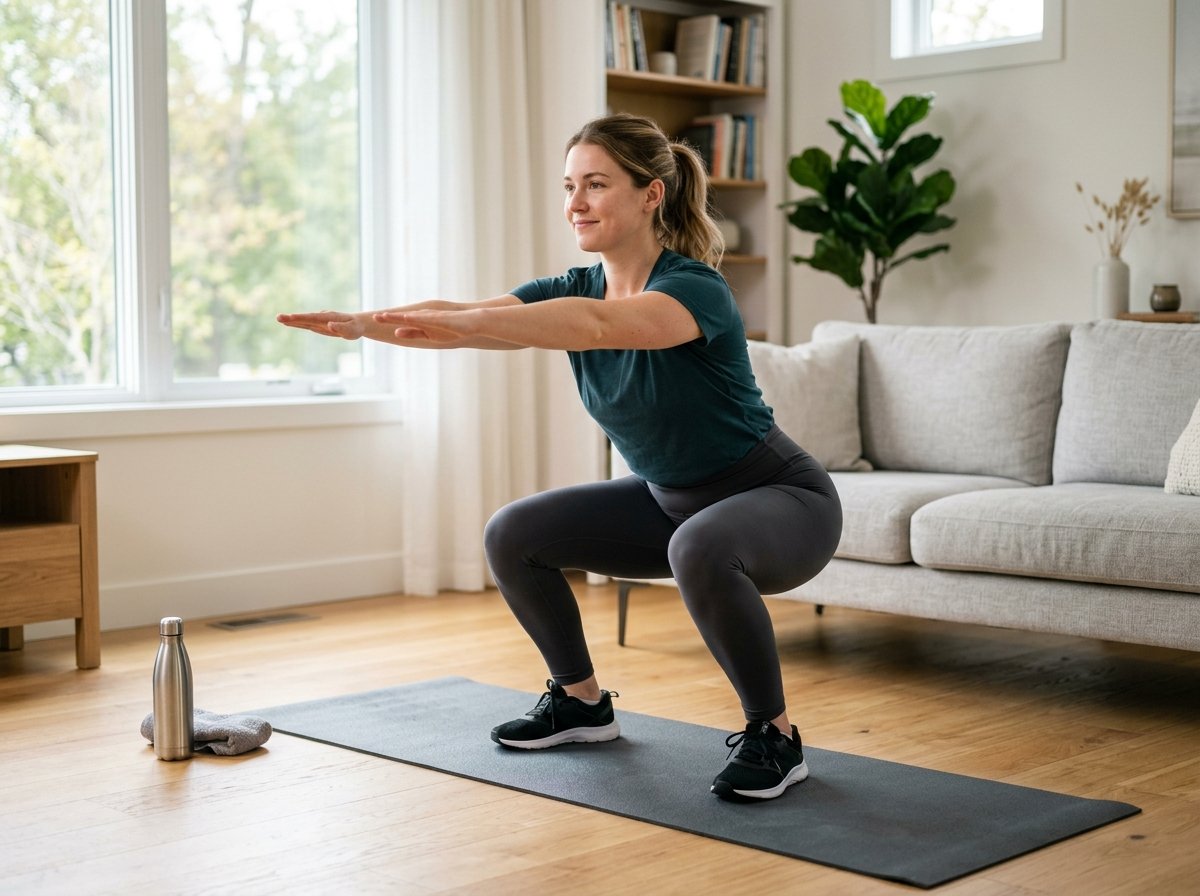
1. Bodyweight Squats
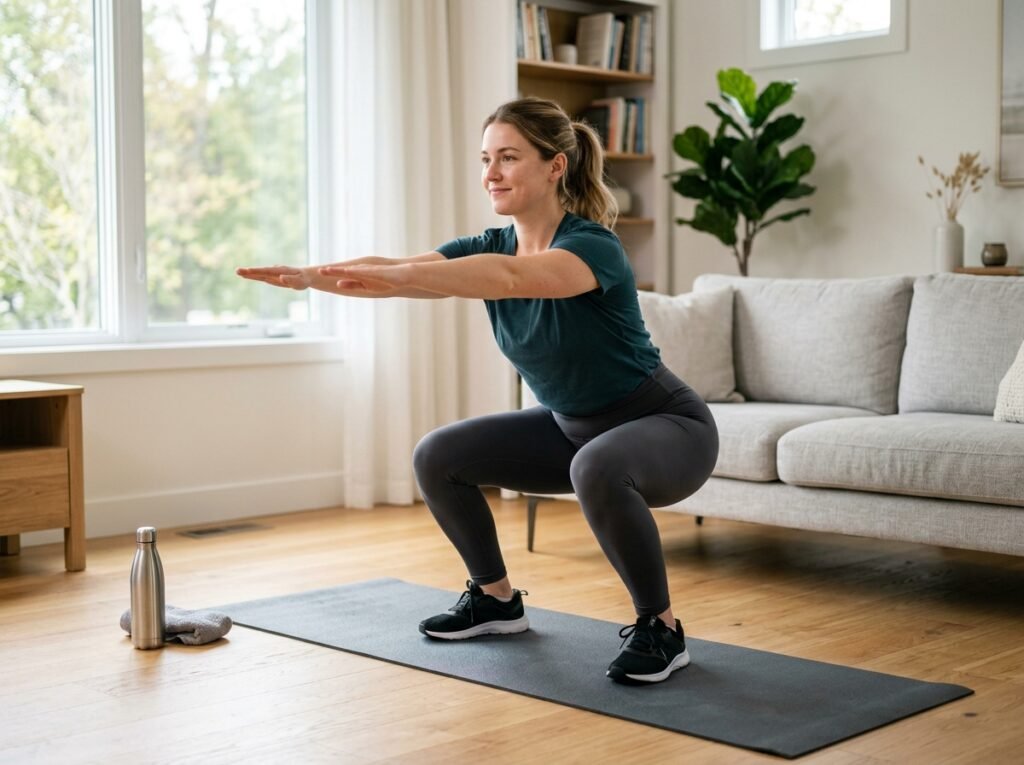
The bodyweight squat is one of the most useful exercises for beginners because it trains a movement you already perform in everyday life: sitting down and standing up.
Stand with your feet approximately shoulder-width apart. Keep your chest comfortably upright and your feet planted on the floor. Slowly bend your knees and push your hips backward as though you were going to sit in a chair.
Lower yourself only as far as you can comfortably control while keeping your balance. Then press through your feet and return to a standing position.
Keep the movement controlled rather than rushing through repetitions.
Beginner suggestion: Start with 8 to 12 comfortable repetitions.
2. Wall Push-Ups
Traditional push-ups can be challenging when you’re just starting out. Wall push-ups provide a gentler way to practice the pushing movement while developing upper-body strength.
Stand facing a sturdy wall and place your hands against it around chest height. Walk your feet slightly backward so your body forms a gentle angle.
Bend your elbows and slowly bring your chest toward the wall. Keep your body controlled, then push through your hands to return to the starting position.
As you become stronger and more comfortable, you can gradually progress to more challenging push-up variations.
Beginner suggestion: Try 8 to 12 repetitions.
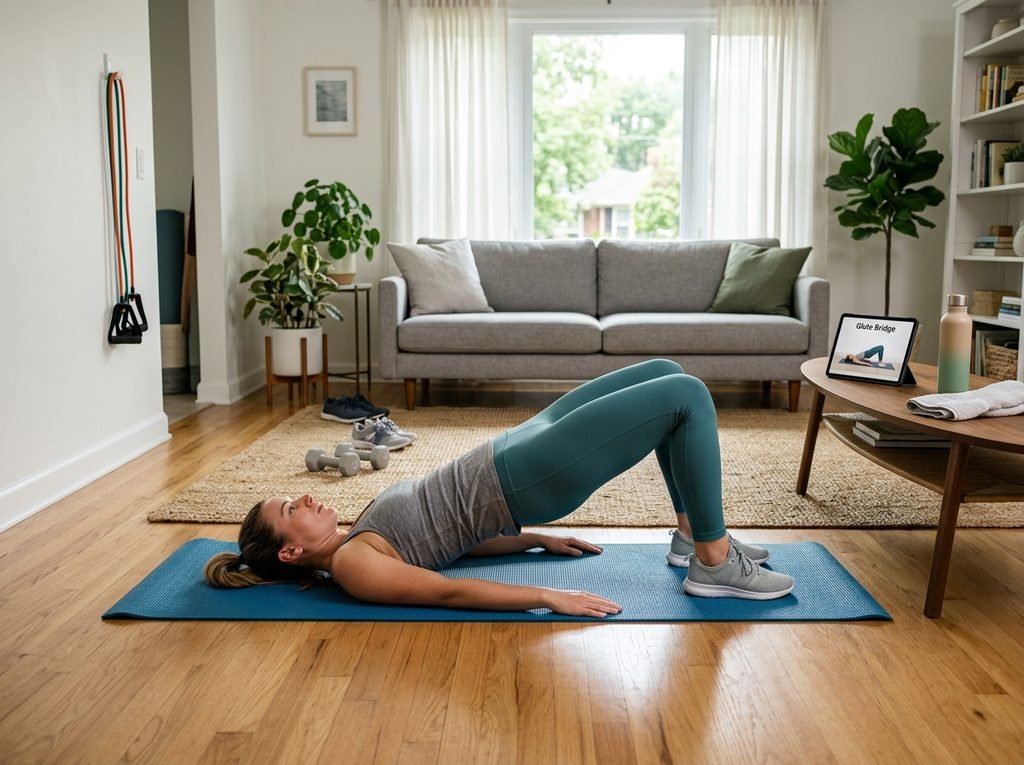
3. Glute Bridges
Glute bridges are a simple floor exercise that focuses on the muscles around the hips and backside while also encouraging controlled movement through the lower body.
Lie on your back with your knees bent and your feet resting comfortably on the floor. Keep your arms relaxed beside you.
Press your feet into the floor and gently lift your hips. Pause briefly at the top of the movement, then lower your hips slowly.
Avoid rushing through the exercise. Controlled repetitions can help you become more aware of how your body is moving.
Beginner suggestion: Perform 10 to 15 repetitions.
4. Standing March
If you want an easy exercise that gets your whole body moving without requiring much space, standing marches are a great choice.
Stand tall and begin lifting one knee at a time while gently swinging the opposite arm. Continue alternating sides at a comfortable pace.
You can start slowly and gradually increase your pace as you become more comfortable.
This movement can also be useful during breaks from sitting because it gets you moving without requiring a large workout area.
Beginner suggestion: March continuously for 30 to 60 seconds.
5. Bird Dog
The bird dog is a controlled movement that challenges balance and coordination while encouraging you to stabilize your body.
Begin on your hands and knees. Keep your hands underneath your shoulders and your knees underneath your hips.
Slowly extend one arm forward while extending the opposite leg backward. Hold the position briefly if you can do so comfortably, then return to the starting position.
Repeat on the opposite side.
There is no need to lift your arm and leg extremely high. The priority is maintaining control and balance.
Beginner suggestion: Perform 6 to 10 repetitions on each side.
6. Step-Back Lunges
Step-back lunges are a beginner-friendly way to train the legs while also working on balance and coordination.
Stand upright with your feet comfortably apart. Step one foot backward and gently lower your body by bending both knees.
Keep the movement controlled and use a range of motion that feels comfortable. Press through the front foot to return to your starting position, then repeat on the other side.
If balancing feels difficult, perform the movement beside a sturdy surface that you can use for light support.
Beginner suggestion: Start with 6 to 10 repetitions per side.
7. Incline Push-Ups
Once wall push-ups become comfortable, you can progress to incline push-ups using a stable elevated surface.
Place your hands on a sturdy surface such as a secure countertop or another appropriate elevated platform. Walk your feet backward and create a straight, controlled body position.
Bend your elbows to bring your chest toward the surface, then push yourself away.
Make sure the surface is stable before beginning. Never use an object that could slide, tip, or collapse during exercise.
Beginner suggestion: Try 6 to 12 controlled repetitions.
8. Calf Raises
Calf raises are extremely simple and require very little space.
Stand upright with your feet comfortably positioned. Slowly raise your heels from the floor so you are standing on the balls of your feet.
Pause briefly at the top if comfortable, then slowly lower your heels back down.
If you need additional balance, stand near a sturdy surface and use it for light support.
Beginner suggestion: Perform 10 to 15 repetitions.
9. Dead Bug
The dead bug is a controlled floor exercise that can help beginners practice coordination and stability.
Lie on your back with your knees bent and lifted into a comfortable position. Keep your arms raised above your shoulders.
Slowly lower one arm and the opposite leg while maintaining control, then return them to the starting position and switch sides.
Move slowly rather than trying to complete as many repetitions as possible. If maintaining the position becomes difficult, reduce the range of motion.
Beginner suggestion: Perform 6 to 10 repetitions per side.
10. Glute Kickbacks
Glute kickbacks are another simple bodyweight movement that can be performed without equipment.
Begin on your hands and knees. Keeping one knee bent, slowly move one leg backward and upward without forcing the range of motion.
Return the leg to the starting position and repeat before switching sides.
Keep your torso stable and avoid swinging the leg quickly. Slow, controlled movement is more useful than simply trying to move as far as possible.
Beginner suggestion: Perform 8 to 12 repetitions per side.
How to Turn These Exercises Into a Beginner Workout
Knowing ten exercises is useful, but you may be wondering how to actually put them together into a workout. The good news is that you don’t need to perform dozens of repetitions or spend an hour exercising.
A simple beginner session can start with a short warm-up followed by several exercises from the list. For example, you could perform bodyweight squats, wall push-ups, glute bridges, standing marches, bird dogs, and calf raises.
Start with one set of each exercise and rest whenever you need to. As your body becomes more familiar with the routine, you can gradually add another set or increase the number of repetitions.
The goal during the first few weeks should be consistency rather than intensity. Finishing a manageable workout and feeling capable of doing it again is often much better than pushing yourself too hard on the first day and struggling to recover afterward.
A Simple 20-Minute Beginner Routine
If you want a straightforward routine to follow, the following structure can be a useful starting point.
Warm-Up — 3 to 5 Minutes
- Easy walking around the room
- Gentle arm circles
- Slow marching in place
- Gentle shoulder movements
- Comfortable leg movements
Main Workout
- Bodyweight squats — 8 to 12 repetitions
- Wall push-ups — 8 to 12 repetitions
- Glute bridges — 10 to 15 repetitions
- Standing march — 30 to 60 seconds
- Bird dog — 6 to 10 repetitions per side
- Calf raises — 10 to 15 repetitions
Rest for approximately 30 to 90 seconds between exercises as needed. Beginners do not need to rush from one movement to another.
Cool Down
After finishing the workout, spend a few minutes walking slowly and allowing your breathing to return toward normal. Gentle stretching can also be included if it feels comfortable.
How Many Days a Week Should Beginners Exercise?
There is no single perfect schedule for everyone. If you’re completely new to exercise, starting with two or three workout sessions per week can be a practical approach.
For example, you could exercise on Monday, Wednesday, and Saturday while allowing recovery days between sessions.
On days when you aren’t doing a structured workout, you can still stay active by taking a walk, doing household activities, spending time outdoors, or simply breaking up long periods of sitting.
As your fitness improves, you can gradually increase the amount of activity you do. The important thing is to build a routine that fits realistically into your life.
Why Consistency Matters More Than a Perfect Workout
One of the biggest mistakes beginners make is believing that every workout needs to be difficult.
Fitness doesn’t develop from one amazing workout. It develops through repeated habits over time.
A simple 20-minute workout that you actually complete several times each week can be much more useful than an extremely demanding workout that you only attempt once every few weeks.
Consistency also gives you time to learn proper movement patterns, understand how your body responds to exercise, and gradually develop confidence.
How to Make the Exercises More Challenging
Eventually, the same exercises may begin to feel easier. That’s a normal part of becoming fitter.
Instead of immediately jumping into advanced exercises, make small changes.
- Add a few repetitions.
- Add another set.
- Slow down the movement.
- Increase the time of an exercise.
- Use a more challenging variation.
- Reduce rest periods slightly if appropriate.
For example, once wall push-ups become very easy, you might progress to incline push-ups. Later, you may work toward a standard push-up if that movement is appropriate for you.
Progress should feel gradual. There is no prize for making your workout harder than necessary.
Listen to Your Body
Exercise should challenge you, but there is an important difference between normal physical effort and warning signs that something may be wrong.
Muscles can feel tired during exercise, especially when you’re new to physical activity. However, sharp pain, significant joint pain, dizziness, faintness, chest discomfort, unusual shortness of breath, or other concerning symptoms should not simply be pushed through.
If something doesn’t feel right, stop the exercise and give yourself time to recover. If symptoms are concerning or persistent, seek appropriate professional medical advice.
Don’t Compare Your Starting Point to Someone Else’s
It’s easy to look at someone else’s workout online and feel as though you’re already behind.
But every person’s starting point is different.
Someone may have been exercising consistently for years, while another person may be completing their first workout in a long time. Comparing the two doesn’t tell you anything useful about your own progress.
Instead, pay attention to your own improvements. Maybe you can perform a few more squats than you could last month. Maybe walking feels easier. Maybe you recover faster after exercise. These small changes matter.
Make Your Home Workout Easier to Stick With
The best workout routine is one that you can realistically continue.
Try keeping your exercise area simple and accessible. You don’t need to create a professional gym in your home.
A small open space, comfortable clothing, a water bottle, and a few minutes of uninterrupted time may be enough to get started.
Some people find it helpful to exercise at the same time each day. Others prefer choosing a flexible time based on their schedule.
You can also prepare your workout area beforehand. If your exercise mat is already available and your workout clothes are ready, starting can feel much easier.
Common Beginner Mistakes
Doing Too Much Too Soon
Excitement is a great motivator, but trying to do an advanced workout immediately can leave you overly tired or discouraged.
Ignoring Technique
Repetitions aren’t the most important part of exercise. Controlled movement and appropriate technique are more valuable than rushing through a large number of repetitions.
Skipping Rest
Rest is part of training. Your body needs time to recover between challenging sessions.
Expecting Immediate Results
Fitness is a gradual process. Strength, endurance, movement confidence, and other improvements take time.
Trying to Copy Someone Else’s Routine
A workout that works for an experienced athlete may not be appropriate for someone who is just beginning. Start at your own level and progress gradually.
Can You Exercise Without Equipment?
Yes. Many useful exercises can be performed with your bodyweight alone.
Bodyweight training can be especially convenient for beginners because there is no need to purchase equipment before developing the habit of exercising.
As you become more experienced, equipment such as resistance bands, dumbbells, or other training tools can provide additional options, but they aren’t required to begin moving more.
What About Walking?
Walking can be an excellent complement to a beginner strength routine.
You don’t need to turn every walk into a high-intensity workout. A comfortable walk can simply give you another opportunity to move throughout the day.
You could combine your home workout with regular walks depending on your schedule, fitness level, and personal goals.
When Should You Increase Your Workout?
There is no need to increase your workout simply because a certain number of days has passed.
Instead, pay attention to how you feel during and after your sessions. If the exercises have become comfortable and you are recovering well, you may be ready to gradually increase repetitions, sets, duration, or difficulty.
Small progressions are usually easier to manage than dramatic changes.
Frequently Asked Questions
Can beginners really exercise at home?
Absolutely. Many basic exercises require little or no equipment, making home workouts a practical option for beginners.
How long should a beginner workout last?
A beginner does not need to exercise for a very long time. A short, manageable session can be enough to establish a routine. You can gradually increase your activity as your fitness improves.
Should I exercise every day?
You don’t necessarily need to perform a structured workout every day. Beginners can benefit from having recovery time between challenging sessions. Light daily movement, such as walking, can complement structured workouts.
What if I can’t complete all ten exercises?
That’s completely fine. Start with a few exercises that feel manageable and gradually add others as you become more comfortable.
Do I need a gym membership?
No. Many beginner exercises can be performed at home without gym equipment. A gym can provide additional equipment and training options, but it isn’t required to start exercising.
Should I feel sore after every workout?
No. Muscle soreness is not a requirement for an effective workout. Focus on gradually improving your fitness rather than trying to become as sore as possible after every session.
Can I modify these exercises?
Yes. Exercise variations can often be adjusted to match your current ability. For example, wall push-ups can be used before progressing to incline or standard push-ups.
Final Thoughts
Starting a fitness journey doesn’t have to involve complicated routines, expensive equipment, or exhausting workouts. The ten exercises in this guide provide a simple foundation for anyone who wants to become more active at home.
Bodyweight squats, wall push-ups, glute bridges, standing marches, bird dogs, lunges, incline push-ups, calf raises, dead bugs, and glute kickbacks can all help you practice basic movements while building confidence.
Most importantly, remember that fitness is not a race. Your first workout doesn’t need to be perfect. It simply needs to be a starting point.
Choose a few exercises, move at a comfortable pace, take breaks when necessary, and gradually build your routine. Over time, those small sessions can become a consistent part of your lifestyle.
And perhaps the biggest advantage of starting at home is that you can begin today. You don’t need to wait for the perfect Monday, the perfect workout clothes, or the perfect fitness plan. Clear a little space, start with a few simple movements, and give yourself permission to improve one step at a time.
Quick Workout Summary
- Workout Type: Beginner Full-Body Workout
- Location: Home
- Equipment: None Required
- Difficulty: Beginner
- Suggested Frequency: 2–3 structured sessions per week
- Focus: Strength, mobility, balance, coordination, and general fitness